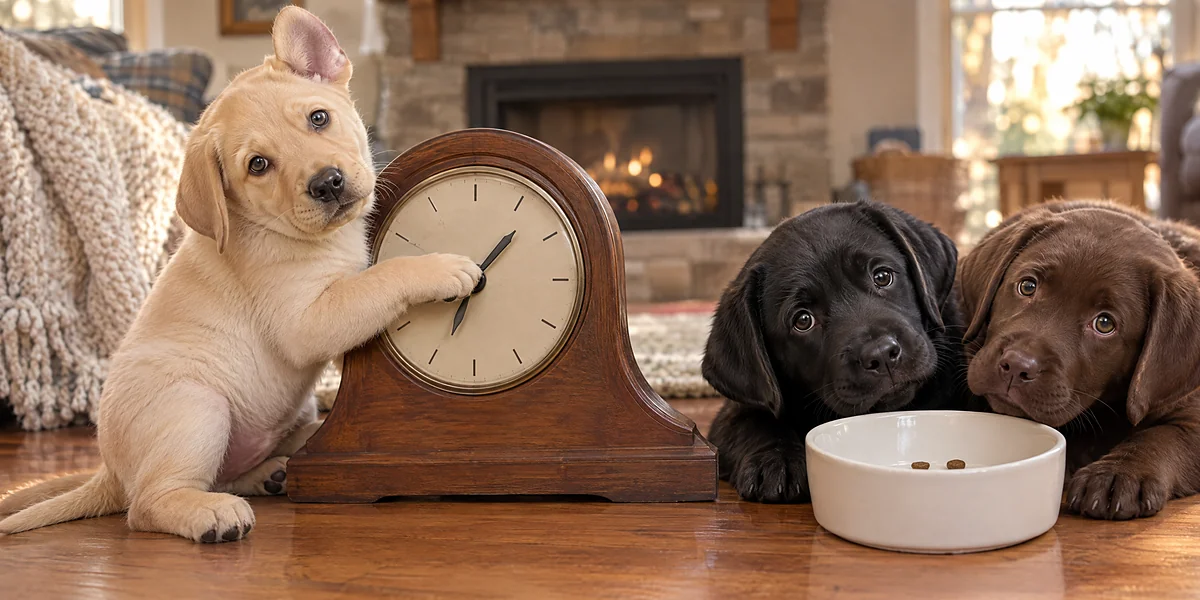
LabPups Adopts Daylight Saving Time, Permanently (The Labs Voted)
 By Tripper WoodLabrador Breeder, LabPups.com
Big news from the LabPups household: our Labradors have voted unanimously to stop changing the clocks twice a year.
Their complaints, filed loudly and mostly at the kitchen door, are feeding-time confusion, anxiety, and the stress of having dinner delayed. (They had no objection to the earlier feeding in the spring. Funny how that works.) So this year, at their insistence, we're planning to stay on daylight saving time when the rest of the country falls back next Sunday, November 1.
Here's the real news behind the joke, plus some practical tips to help your own Lab through the switch.
The Labs' Case Against "Falling Back"
Labs run on routine. Breakfast, potty break, walk, nap, dinner, repeat. When the clocks fall back, a Lab who usually eats at 7:00 a.m. wakes up hungry at what the clock now calls 6:00 a.m. Then everybody makes them wait. From a Lab's point of view, that's a scandal.
The American Kennel Club agrees that the routine part is real. In its guide to how daylight saving time affects your dog's routine, the AKC says dogs are creatures of habit and that a sudden shift in their schedule can unsettle and confuse them. It also notes that most dog researchers don't think dogs grasp time the way we do, but they do perceive time passing, and they will definitely let you know when it's time to eat.
What's Actually Happening With the Clocks This Fall?
Daylight saving time ends on Sunday, November 1, 2026, at 2:00 a.m. local time. Clocks go back one hour to 1:00 a.m., and that hour repeats. Most of the country falls back. Hawaii and most of Arizona don't observe DST at all. You can confirm the date on the 2026 U.S. daylight saving time schedule from timeanddate.com and on NIST's daylight saving time rules page. NIST is one of the nation's official timekeepers.
The bigger question is whether the switching stops for good. The Sunshine Protection Act would make daylight saving time permanent. It passed the U.S. House 308–117 on July 14, 2026, but the Senate hasn't voted on it, so the clocks still change this fall. President Trump has repeatedly urged Congress to "lock the clock" on daylight saving time. At LabPups, we (and our Labradors) wholeheartedly support that effort.
The Arkansas Objection
The best-known holdout is U.S. Senator Tom Cotton of Arkansas. He's worried that permanent daylight saving time would mean very late winter sunrises. In his Senate floor speech opposing the Sunshine Protection Act, he said that "three months out of the year, kids in towns like Bentonville, Fayetteville, and Fort Smith would start school ahead of the sun."
We passed that concern along to the Labs. They were not swayed.
The Labs' Rebuttal
The Labs pointed out that schoolkids farther north have been heading to the bus in the dark for years. In Utqiaġvik, Alaska (formerly Barrow), the sun doesn't rise at all for roughly two months every winter. That's the "polar night," which usually lasts about 64 to 66 days, depending on the year.
They also had a sharp legal point: a state can already choose its own path. Under the federal Uniform Time Act, a state may opt out of daylight saving time and stay on standard time all year, the way Hawaii and most of Arizona do. (Federal law does not currently allow a state to pick permanent daylight saving time on its own. That takes Congress.) So if Arkansas prefers standard time, the Labs say, Arkansas is welcome to keep it.
Our Official (Tail-Wagging) Policy
In support of our Labradors, LabPups is done waiting on Washington. For the first time ever, our kennel clocks will not be falling back on November 1.
Please note that our hours of operation will stay steady all year long. If you're living on Standard Time like everyone else, here's your Lab Time conversion: Lab Time runs one hour ahead of Standard Time, so a 10:00 a.m. Lab Time visit is 9:00 a.m. on your phone.
(Real talk from the humans: your appointment confirmation is always the time to go by. If you're ever unsure, just contact us or call (704) 504-7931 and we'll sort it out, no head tilts required.)
Real Talk: How to Help Your Lab Through the Time Change
Our Labs may have seceded from standard time, but yours probably live with humans who will change the clocks. Here's how to make it easier on them, based on the AKC's guidance:
- Start a few days early. The AKC recommends gradually adjusting your dog's schedule for eating, walking, and bedtime during the week before the time change, instead of moving everything a full hour overnight. With the change on November 1, this week is the time to start.
- Shift in small steps. For fall back, push meals and walks a little later each day (for example, about 15 minutes at a time). That way, by Sunday, "the usual time" on the new clock feels normal to your dog.
- Keep everything else consistent. Same food, same bowl, same walk route, same bedtime rituals. Familiar routines help dogs feel secure.
- Expect a few off days. The AKC notes that some dogs get anxious, have a nervous stomach, or have potty accidents when their routine suddenly changes. Be patient, add an extra potty break if needed, and call your veterinarian if anything seems more than a little off.
- Puppies need extra structure. If you're bringing home a new Lab puppy this fall, set a reliable schedule from day one. The AKC says routine and consistency bring stability and confidence to dogs. A steady routine also pays off in training. Our obedience training program builds on exactly that kind of consistency.
Curious how fast that new puppy will grow into a full-sized, breakfast-demanding Lab? Check out our guide: How Big Will My Lab Puppy Get?
Bringing Home a Lab Puppy This Fall?
Whether your house runs on Standard Time, daylight time, or Lab Time, there's always room for one more set of muddy paws. Our AKC Labrador Retrievers are raised in the house by the same Charlotte, NC family that's been breeding Labs since 1991, right in the middle of the daily routine (and the feeding-time debates).
- See our available Labrador puppies
- Check out our upcoming litters, or reserve a future puppy
- Meet our Lab parents
- Questions? Contact the LabPups family or call (704) 504-7931
Frequently Asked Questions
When do the clocks fall back in 2026?
Daylight saving time ends on Sunday, November 1, 2026, at 2:00 a.m. local time. Clocks move back one hour to 1:00 a.m. Most of the U.S. changes, but Hawaii and most of Arizona do not observe DST.
Is daylight saving time becoming permanent?
Not yet. The Sunshine Protection Act would make daylight saving time permanent nationwide. It passed the U.S. House 308–117 in July 2026, but the Senate hasn't voted on it, so the clocks still change this fall.
Do dogs notice when the clocks change?
Yes, mostly through their routine. According to the AKC, dogs are creatures of habit. They don't understand clock time, but they do notice when meals, walks, and bedtime suddenly shift.
How should I adjust my dog's feeding schedule for fall back?
Start several days ahead and move meals and walks later in small steps, about 15 minutes a day. By the time the clocks change, the new "normal" time will feel familiar.
Can a state stop changing its clocks on its own?
Yes, but only in one direction. Under federal law, a state can opt out of daylight saving time and stay on standard time year-round, like Hawaii and most of Arizona. Permanent daylight saving time requires an act of Congress.
All the best from our family to yours,
The LabPups Family, Charlotte, NC
Interested in a Labrador Puppy?
Check out our available puppies or learn more about our breeding program